
| Starting point | Above-ground stems or branches |
|---|---|
| Root category | Adventitious aerial root |
| Grounded stage | Prop or pillar root |
| Function | Support and connection to soil |
| Timing | Variable; no universal number of days |
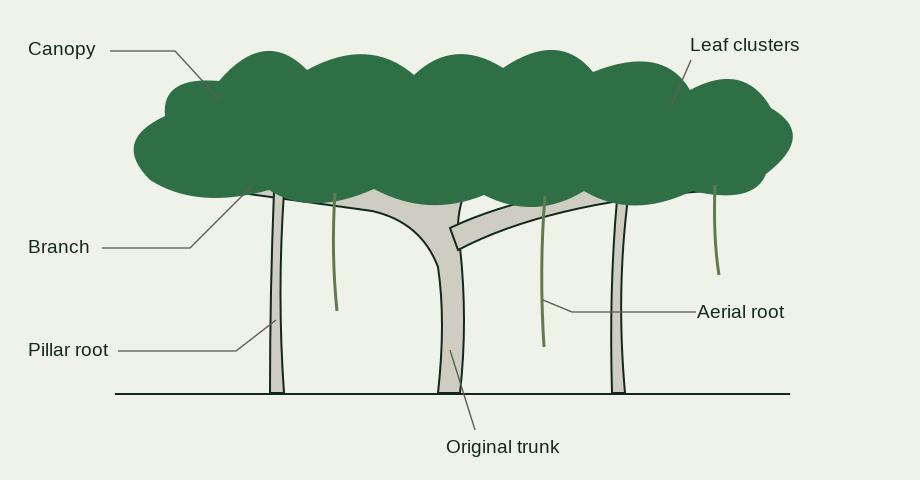
Why does a branch grow a root?
“Adventitious” describes a root arising from somewhere other than the normal primary root system. “Aerial” tells you that it is growing in the air. These words describe origin and position, not a separate organ halfway between a root and a branch.
A banyan uses this capacity to build additional connections beneath its canopy. The root can descend from a point that is already far from the original trunk. It is a direct physical reason that mature banyans can take on a sprawling, supported form.
What changes when the root reaches soil?
Once a descending root establishes in soil, it can grow thicker and become a load-bearing pillar. Seen at ground level, it may resemble a narrow trunk. Look up to find its connection with the branch above.
A pillar supports the tree where it stands; it should not be treated as a loose ornamental cord. Cutting mature roots can change the tree’s structure. Around buildings or paths, decisions about them belong in an assessment of the whole tree, its condition and its site.
Why are some roots long and others short?
Different roots start at different times and heights, and not all survive to become pillars. Humidity, exposure and the growing conditions influence what the observer sees. A photograph captures one moment rather than a fixed set of stages with a reliable timetable.
There is therefore no honest general answer such as “every aerial root reaches the ground in six weeks”. For a bonsai, deliberate training adds another set of conditions. The bonsai aerial-root guide addresses that setting separately from a mature outdoor tree.
What does the genome research actually show?
The 2020 genomic research studied Ficus microcarpa, the Chinese banyan. It linked aerial-root development with auxin-related genetic pathways and gene duplication. That is evidence about a named species and a developmental process, not proof that manipulating one variable will make any houseplant grow a curtain of roots.
The practical distinction is simple: a beautiful explanatory diagram should retain the botanical name. Our biology guide keeps studies of F. microcarpa separate from the Indian banyan, F. benghalensis.
Sources
- Ficus benghalensisNational Parks Board, Singapore · Accessed 2026-11-24
- Ficus benghalensis: banyanRoyal Horticultural Society · Accessed 2026-11-24
- Ficus benghalensis: species overviewUniversity of Florida / IFAS · 2026 · Accessed 2026-11-24
- Genomes offer new insights into fig–wasp symbiotic systemChinese Academy of Sciences · 2020 · Accessed 2026-11-24
- Genomes of the Banyan Tree and Pollinator Wasp Provide Insights into Fig–Wasp CoevolutionZhang et al., Cell · 2020 · Accessed 2026-11-24