
| Scientific name | Ficus benghalensis L. |
|---|---|
| Family | Moraceae, the mulberry family |
| Native range | Indian subcontinent |
| Signature feature | Aerial roots that become supporting pillars |
| Pollinator | Eupristina masoni, a fig wasp |
| Houseplant form | Ficus benghalensis ‘Audrey’ |
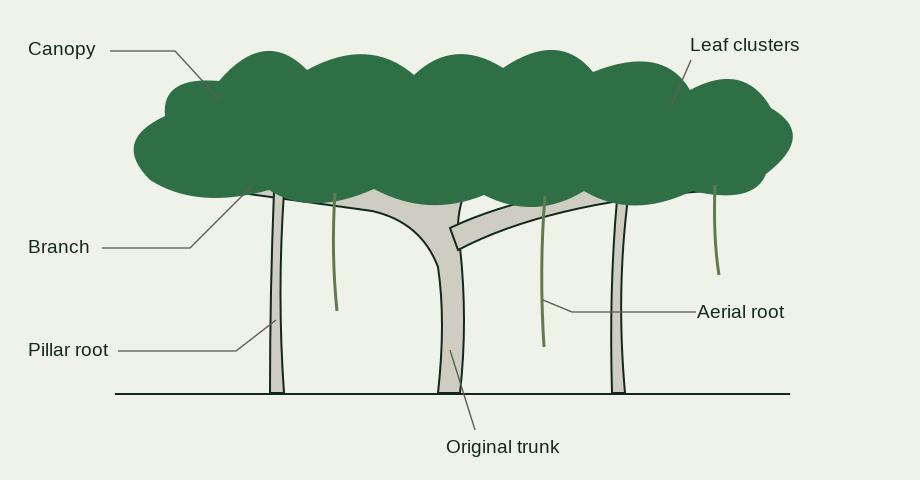
How can one tree look like a forest?
Follow a low branch away from the centre of an old banyan and the apparent forest begins to make sense. What looks like a neighbouring trunk may be a root that descended from that branch. Once rooted in soil, it can become a woody support. The canopy continues beyond the original trunk, and the tree acquires a colonnade.
The additional pillars belong to the same tree. Their presence does not mean a grove of seedlings has grown together. This is why canopy area, original-trunk size and number of prop roots describe different aspects of a banyan; they should never be treated as interchangeable measures of greatness.
Does every banyan start in another tree?
In forests, animals may leave seeds in a fork or crevice high in a host tree. A seedling can begin there and send roots towards the ground. The descending roots may eventually surround the host, producing the characteristic strangler form. A banyan planted directly in soil does not need a host in order to grow.
Read the strangler life cycle as a possible developmental pathway, not a rule that every cultivated banyan must follow. The same species may look very different as a houseplant, a young garden tree and a centuries-old spreading specimen.
Which trees are really banyans?
Ficus benghalensis is the Indian banyan. F. microcarpa, often sold for bonsai, is a different species. The sacred Bodhi or peepal tree is F. religiosa. The Australian Moreton Bay fig is F. macrophylla. They are relatives, but their leaves, natural distributions and practical growing considerations differ.
A common name is a useful starting point, not a botanical identification. Our species directory keeps the scientific name beside the familiar one. Use the identification key to narrow possibilities, then confirm them with a regional flora or qualified botanist.
Why do people gather beneath them?
A mature canopy creates a place to meet as well as shade. Banyans occur in stories, religious practices and civic life across South and Southeast Asia. India recognises the banyan as its national tree. Specific traditions belong to particular communities; they should not be flattened into a single universal meaning.
The tree also makes a large physical commitment. Its roots and canopy need room. Admiring a landmark banyan and choosing a tree for a small garden are different decisions. Begin any planting plan with the relationship between roots and buildings.
In this guide
Sources
- Ficus benghalensisNational Parks Board, Singapore · Accessed 2026-11-24
- Ficus benghalensis: banyanRoyal Horticultural Society · Accessed 2026-11-24
- Ficus benghalensis: species overviewUniversity of Florida / IFAS · 2026 · Accessed 2026-11-24
- National Tree: The BanyanBotanical Survey of India · Accessed 2026-11-24
- BanyanEncyclopaedia Britannica · Accessed 2026-11-24