
| First foothold | A branch fork or other suitable crevice |
|---|---|
| Early habit | Epiphytic |
| Later connection | Roots reach soil |
| Possible result | The host is enclosed and lost |
| Important limit | Not every cultivated banyan has a host stage |
From a small seed to a supporting network
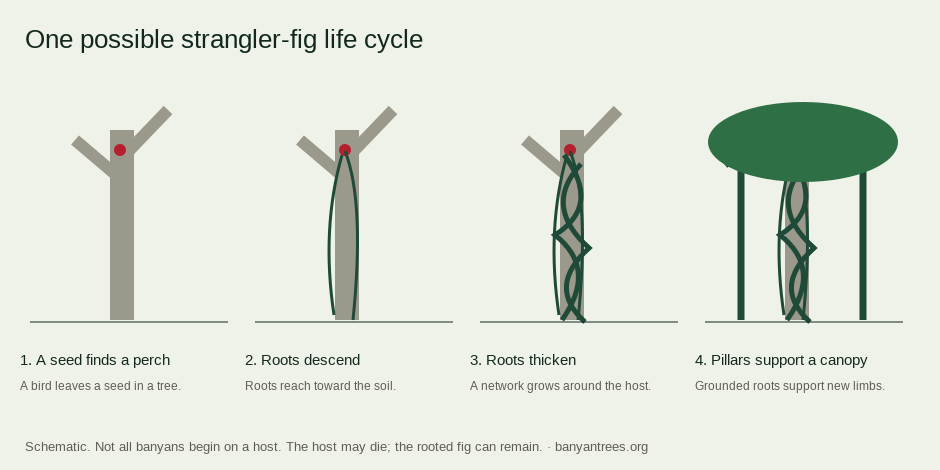
- A seed arrives. A fruit-eating animal carries or deposits it in a suitable place, sometimes high in another tree.
- A seedling establishes. The young fig occupies a crevice with enough moisture and material to support growth.
- Roots descend. The fig begins to connect its elevated starting point with the ground.
- The network thickens. Roots and stems expand around the host as the fig grows.
- The host may be lost. Competition and encasement can leave the fig around a dead or decaying original support.
- The fig stands independently. A mature tree may continue expanding its crown and root supports.
Is it a parasite?
An epiphyte begins on another plant as a place to grow. That description is different from a parasite taking resources through a specialised connection into the host. “Strangler” describes the eventual form and effects of the fig’s growth; it does not erase the distinction.
The host can still be harmed. A developing root envelope, crown competition and the weight of the fig all belong in the story. Reducing the process to a cartoon of a tree being squeezed misses the long transition from seedling to large, independent plant.
Does a hollow centre prove the whole story?
A hollow space can be consistent with the loss of an earlier host, but a mature tree’s form alone is not a complete historical record. Decay, broken stems, maintenance and subsequent growth may also have changed what remains.
A careful description distinguishes an observed feature from an inferred history. “Roots surround a hollow space” is an observation. “This exact host died in this exact year” requires evidence beyond a photograph. The same rule applies to temple trees and dramatic social-media images.
Where does the banyan fit?
The Indian banyan is one fig capable of this habit. Florida’s native strangler fig, Ficus aurea, is another. A species name tells us which plant is involved; “strangler” tells us about a way of growing.
This distinction matters for ecology and planting. A native strangler fig and an introduced banyan may create superficially similar roots while having very different regional status. Use the banyan–strangler comparison to keep habit, species and local context separate.
Sources
- Ficus benghalensis: species overviewUniversity of Florida / IFAS · 2026 · Accessed 2026-11-24
- Ficus aurea: Strangler FigUniversity of Florida / IFAS · Accessed 2026-11-24
- Ficus benghalensisNational Parks Board, Singapore · Accessed 2026-11-24